Read me on a computer screen please!! Improper layout on phone!

Hi! I coded this site myself so if it's a little janky I apologise I am still learning. I have also submitted a word pdf version of this assignment in case it breaks / is unreadable for whatever reason.
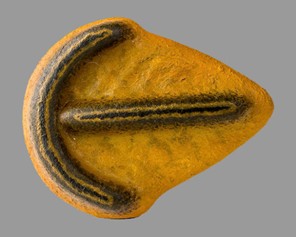
Media response to the possible mobile lifestyle of Parvancorina ✦ April 17th 2025

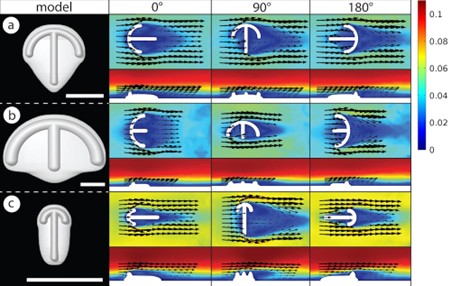
The paper I am looking at today was written in 2017 by Simon Darroch, Imran Rahman and team. In the paper, we look at how the team used computational fluid dynamics (CFD) to make estimations about how genus Parvancorina lived. They note that most researchers consider Parvancorina to be sessile due to the lack of associated trace fossils. Using the results of the fluid dynamics tests, the team concluded that the lifestyle of a sessile suspension feeder was unlikely since it was only most optimal facing a specific direction into the current.
Overall, I found the paper to be pretty well written, much of the language used was relatively straightforward in a way that allowed it to be followed relatively easily, a good mix of English and jargon.

Image of CFD results

The reaction of news outlets to the paper loved to play to the mystery surrounding the Ediacaran, for which I can hardly blame them! Most of the reports surrounding this paper seem to be an introduction of the Ediacaran to a general audience, which is fantastic because I think more people should care about the Ediacaran!
The news articles spend most of their time giving some background to the Ediacaran, such as when it was and the sort of organisms that live there. Yahoo had a particularly descriptive introduction, outlining just why the Ediacaran is so interesting and why it is so difficult to study it.

Image of CFD results

The news release by Vanderbilt University discusses that the research that has been done was also backed up by an independent study that was done here in South Australia, looking at how many of the other species in the area had been in some way buffeted by the current and were in a state of disarray, when the Parvancorina were seemingly unaffected and continued to all face the current in a specific way.
I found there was a not insignificant amount of Japanese twitter users who also noticed the paper, though unfortunately I found the link to the Japanese news source to be broken, I did manage to find an article of the same title but I cannot read Japanese and the translator was unclear at best. Not super helpful, but I just thought that it was interesting.
Another article I found was written in Russian, which I ran through a translator and was readable to me! The article goes over much the same things as many of the other articles, giving a short explanation to what the Ediacaran period is, before delving into explaining what has been done in the study.
Finally, the researchers themselves put out an article in the conversation, which was seen by many conversation regulars. A few of the commentors on the article post had some interesting questions for the researchers. One commentor asked about the conditions of the water within the Ediacaran seas and whether they were very different to the seas of today, which could possibly prove a problem to the calculations within the fluid dynamics. Another commentor made mention of the assumption that Parvancorina was a suspension feeder, and further that it was an animal at all! Stating that it is possible that it could even be a species of plant or fungus. And that, even if this was an animal, that it is possible that this animal is incomplete.

Image of CFD results

In my opinion, I agree with the comment. It seems a little odd to assume this organism to be a suspension feeder. Though it was common at the time, it very easily could have been a plant-like organism of some description, which may have photosynthesised. Given it were an animal-like organism, how do we know this isn’t another “Anomalocaris situation”? In which the fossil is merely a piece of a complete whole. Overall, I find the paper to be compelling, it is finding a relatively effective way to estimate how these ancient organisms could have lived. Many of its pitfalls simply come as the difficulties of studying such ancient and alien life.


Original article

Darroch, S. A. F., Rahman, I. A., Gibson, B., Racicot, R. A., Laflamme, M. 2017 Inference of facultative mobility in the enigmatic Ediacaran organism Parvancorina. Biology Letters 13(5): 20170033.


Page decoration